sat suite question viewer
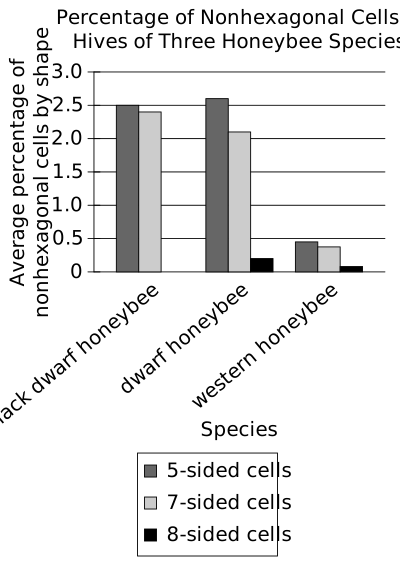
- All values are approximate.
- For each data category, the following bars are shown:
- 5-sided cells
- 7-sided cells
- 8-sided cells
- The average percentage of nonhexagonal cells by shape data for the 3 categories are as follows:
- black dwarf honeybee:
- 5-sided cells: 2.5 percent
- 7-sided cells: 2.4 percent
- 8-sided cells: 0.0 percent
- dwarf honeybee:
- 5-sided cells: 2.6 percent
- 7-sided cells: 2.1 percent
- 8-sided cells: 0.2 percent
- western honeybee:
- 5-sided cells: 0.45 percent
- 7-sided cells: 0.38 percent
- 8-sided cells: 0.08 percent
- black dwarf honeybee:
Honeybee hives consist mainly of hexagonal (six-sided) units called cells, in which queens lay eggs. Hexagonal cells for eggs that develop into nonreproductive workers are smaller than those for eggs that develop into reproductive drones, though the size difference varies by species. Difference in cell size results in a construction problem—it’s hard to neatly connect sections of small cells to sections of large cells—that worsens as the difference increases. To fill in gaps between the sections when building a hive, bees rely on cells that have more or fewer than six sides. A student studying beehive structure consults data on three species, concluding that blank
Which choice most effectively uses data from the graph to complete the student’s conclusion?
Explanation
Choice A is the best answer because it most effectively uses data from the graph to complete the student’s conclusion about beehive structure. The text explains that in the hives of honeybees, the hexagonal cells housing drone eggs are larger than the hexagonal cells housing worker eggs, and that this size difference results in a construction problem that the bees address by using nonhexagonal cells to fill gaps between sections of drone-egg cells and worker-egg cells. The text also states that the size difference between drone-egg cells and worker-egg cells varies by species of honeybee. The graph displays data on the percentage of nonhexagonal cells in the hives of three species. In the hives of the western honeybee, the percentages of five-sided, seven-sided, and eight-sided cells are all less than 0.5%. But in the hives of the black dwarf honeybee, the percentages of five-sided and seven-sided cells are higher than those for the western honeybee: about 2.5% for both. And for the dwarf honeybee, the percentages of five-sided and seven-sided cells are also higher than those for the western honeybee: slightly over 2.5% and slightly over 2.0%, respectively; additionally, the dwarf honeybee possesses a higher percentage of eight-sided cells than the western honeybee does. Taken altogether, the graph shows that the hives of the western honeybee consist of a smaller percentage of nonhexagonal cells than the hives of the two other species do. Since the nonhexagonal cells exist only to solve the construction problem arising from the difference in size between drone-egg cells and worker-egg cells, a smaller percentage of nonhexagonal cells would be associated with a smaller size difference between the two types of cells. Therefore, it can be concluded from the data that worker-egg cells are probably closer in size to drone-egg cells in the hives of the western honeybee than in the hives of the other two species.
Choice B is incorrect because, as the text states, honeybee species deposit their eggs in hexagonal cells, not in nonhexagonal ones. Thus, the western honeybee and black dwarf honeybee wouldn’t deposit drone eggs in eight-sided cells, and the dwarf honeybee wouldn’t deposit drone eggs in seven-sided cells. Choice C is incorrect. The text explains that honeybees rely mainly on one geometric shape, the hexagon, when constructing their hives, and the graph shows that the western honeybee relies on the same nonhexagonal shapes as the dwarf honeybee does: five-sided, seven-sided, and eight-sided cells. In other words, the western honeybee and dwarf honeybee rely on the same number of geometric shapes. For the black dwarf honeybee, the graph displays data only for five-sided and seven-sided cells, which suggests a total absence of eight-sided cells. Yet this would be only one less nonhexagonal shape than is seen in the western honeybee. Thus, based on the graph, it would be inaccurate to say that the western honeybee relies on "many more" geometrical shapes than the other two species do. Choice D is incorrect. As the text explains, honeybee hives consist mainly of hexagonal cells, and sections of nonhexagonal cells are used to connect sections of hexagonal cells of different sizes. Since the graph indicates that the percentage of nonhexagonal cells is lower for the western honeybee than it is for the dwarf honeybee or black dwarf honeybee, the western honeybee would conversely have a higher percentage of hexagonal cells than the either the dwarf honeybee or black dwarf honeybee does, not a lower percentage.